CO2 avoided by extending lifespan
This is the heart of LongLife's environmental value. Each device you keep in service instead of replacing avoids manufacturing a new one, thus avoids the largest share of its carbon footprint.
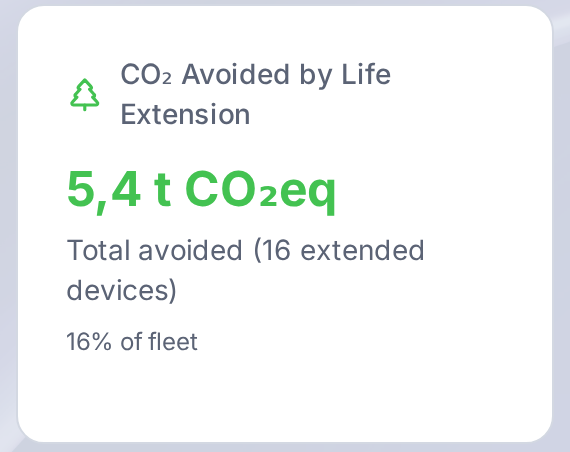
The principle
A device has an "expected" lifespan. Beyond it, if it is still in service thanks to LongLife (optimization, upgrade rather than replacement), a new-device manufacturing is considered avoided. The corresponding CO2 is counted as avoided, and accumulated at fleet scale.
What it makes tangible
You get a concrete, cumulative figure: "thanks to lifespan extension, your fleet has avoided X kg (or tonnes) of CO2". It is the tangible proof of the positive impact of your approach, usable in your communication and your CSR indicators.
The link with your decisions
Every extension decision (via an intervention rather than a replacement) feeds this counter. Environmental and economic go together: extending means both less CO2 and less spending.