Rationalization and savings
This is where AppBox turns findings into decided savings. Opportunities are grouped and quantified, and a slider lets you arbitrate between savings and safety.
The opportunities (the cases that save money)
AppBox surfaces typical situations, quantified:
- The ghost application: installed, never opened -> uninstall or do not renew.
- The dormant seat: license paid but application not installed -> cancel or reassign.
- Marginal usage: rarely-used application -> switch to a free or web version.
- The functional duplicate: two applications in the same category on a device -> standardize.
- Shadow IT (SaaS): an online subscription detected without a declared license -> hidden cost to frame.
- Left behind at departure: device gone, license still assigned -> clean up.
Each opportunity is presented as an action batch ("18 dormant Office licenses -> 2,160 EUR/year"), not a passive list: you act on a group.
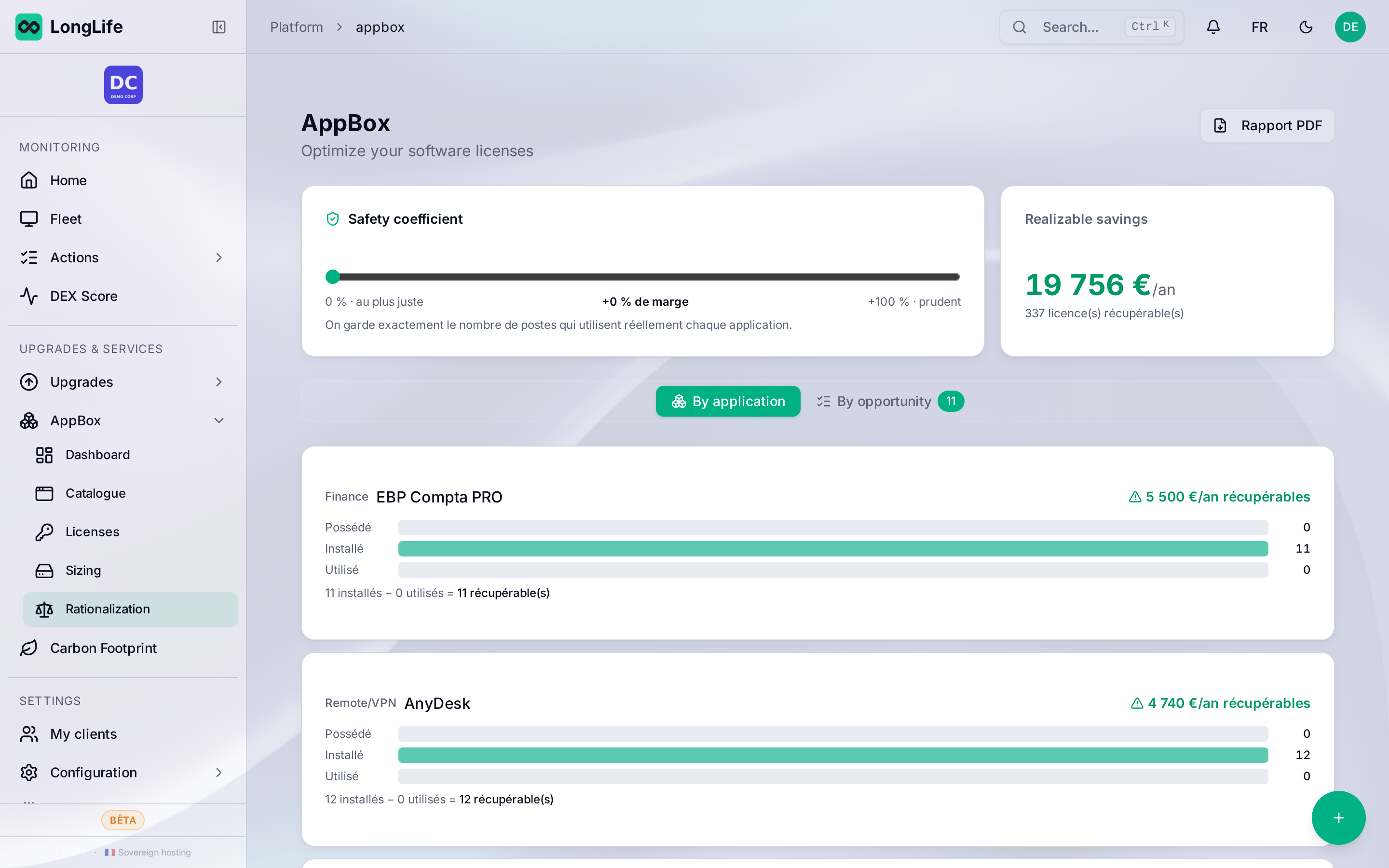
The safety coefficient
This is the key idea to decide with confidence. A slider lets you keep a margin above real usage, to answer the fear "what if someone needs it?".
- Low coefficient: you size close to real usage. Maximum savings, minimum margin.
- High coefficient: you over-provision. Safety margin, lower savings, near-zero risk.
The formula: estimated need = devices using × (1 + coefficient). You never rationalize below
this need. The slider recomputes live the number of licenses to keep and the achievable savings,
and the chosen coefficient is shown in the report (an assumed hypothesis).
The virtuous loop
Detect -> decide -> act (via a batch uninstall intervention) -> the agent re-measures -> the gap shrinks -> the saving is proven. AppBox does not just advise: it loops on action and measurement. Execution goes through interventions.
The deliverable
Your decisions materialize in the software estate report, transferable to your finance department.